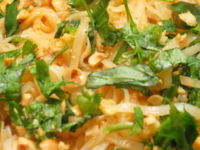
 Staple Carbohydrate: Rice
Other Staple Ingredients: meat, sea food, vegetables.
Common Ingredients: chili, coconut milk, garlic, limes, peanuts, fish sauce, shrimp paste
”
If you have food allergies, the easy thing about Thailand is that they cook their food in the traditional way, so you can usually work out what is safe and count on it to use the same ingredients at different food vendors.
The challenge about Thailand is that it is a very difficult country to communicate in. Although many Thais in touristed areas appear to have good English, some have only just enough to take your order, although they appear to understand more than they really do. Asking exactly what is in the food, and attempting to order a special meal is unlikely to succeed (fancy tourist resorts are probably an exception). In areas with few or no tourists, you will have to learn at least some Thai to find out what is and is not in the food. They will think you highly odd for asking, but they think all foreigners are odd – they are likely to be tolerant.
Easy to Avoid Allergenic Foods in Thailand
- Wheat – (as long as you are not too sensitive). Soy sauce is a common ingredient, and it does have a tiny amount of wheat in it. Other sauces may also be a problem. Watch out for yellow noodles. White rice noodles are available everywhere. Often they are right next to each other in the food stall, so watch out for stray yellow noodles in with your rice noodles.
- Milk – not used in traditional Thai cooking
- Yeast
- Corn
- Oats
Hard to Avoid Allergenic Foods in Thailand
Notes
- Thais love meat! Strict vegetarians will have very limited choices, although it is possible to get many dishes with almost no meat
- The cuisine is very regional in Thailand. Some dishes are available throughout the country, others only in certain provinces.
Note that fish sauce is used in some Thai cooking, and may contain wheat. This may be more common in Thai restaurants located in Western countries than in Thailand itself, and may depend on the region. This area needs more research. If you can add further information, please leave a comment. Thanks to Sea for pointing out the possibility of wheat in some brands of fish sauce (Thai Food, dangers of).
{ 22 comments… read them below or add one }
Hello,
I have soy allergy and was wondering what would be safe to order when out at street vendors?
Hello, My son and I will be leaving for Thailand on August 24th. He has some food allergies that are not life threatening, but cause him to get really bad eczema. He is allergic to Wheat, Gluten and any kind of egg. He also has a mild mushroom allergy. Any foods we should avoid while in Thailand?
Hi,
I am planning to go travelling to Thailand, Cambodia, Vietnam for three months. I am allergic to sesame seeds and all nuts, as well as being a vegetarian (no fish either)!
I was planning on buying food to eat from supermarkets (or such like) whilst out there, as I assume there will not be much luck when eating out in restaurants. Do you know if they have suitable foods available in any supermarkets? Or if this is even a good plan at all?
Thank you!
Hello, I’m travelling to Thailand soon and I am allergic to… SOY!
Watch out for tofu and soy sauce! Learn the names for Thai dishes that you can eat, as you discover them, so you can ask for them by name. The street stalls are amazing in Thailand, but they usually don’t have menus and it is hard to point at what you want, they have so much hidden away in their stalls. Ask friendly locals who speak English for help (but watch out for con-artists! Unfortunately many apparently friendly and English-speaking Thais are con artists in tourist areas.)
Hello Javi,
I’m also traveling to Thailand & Burma, and also allergic to SOY.
Can you tell me how your travel did go, and what to avoid & ask?
Greetings from Belgium
Any thoughts for folks allergic to shrimp? Will there be shrimp paste in unlikely dishes in Thailand?
Shrimp is fairly common in Thailand. The definition of ‘unlikely’ is probably more cultural than anything, so the answer to that question is probably ‘yes’. On the other hand, don’t expect it to be in everything.
Cooking styles seem to vary around the country, although when I was last there, there was plenty of sea food well inland.
I have a weblog about traveling with an allergy. It also features Thailand.
Take a look if you are interested: travelallergy.blogspot.com
Hello all, I just had a second very bad reaction to Thai food. The first time I wrote it off as other issues. I do eat Thai, Chinese, etc. fairly regularly so can rule out regular items like milk, coconut, peanuts… but both times were a red curry dish. My main suspect now is lemongrass…
Was your meal in Thailand (or some other SE Asian country) or in a Western country?
One thing to consider is that many ethnic restaurants take shortcuts, so the ingredients may not be according to tradition, ingredients may be substituted, and food additives may be included that you are not used to.
Of course you may be right that it’s the lemongrass.
Another thing: Thais love MSG and put it in everything. The secret to Thai cooking, i sometimes think, is sugar and MSG. So anyone allergic to MSG I think should avoid almost all savory street food.
If you have a (dairy) allergy, be very very careful in Thailand. 1) the ingredient labeling is terrible. Very often they only state the MAIN ingredients! (we found this out the hard way and had to use the epipen!)
2) A lot of the food is produced abroad (e.g. Malaysia) and contains traces of allergens. At least this is stated on the packaging. So, all of a sudden products that are allergen-free in your own country “contain traces of….”
3) They just LOVE dairy. We even found dairy in 1) nearly every brand of SOY-milk 2) most cereals 3) french fries 4) canned fish 5) ALL the bread & crackers etc, etc, etc.
It is definitely NOT safe for people with a dairy allergy to go to Thailand unless you buy your food in European shops such as Carrefour, buy European/ US/ Australian products (and even then it’s difficult to find what you need) and cook it yourself!
Where you eating at resorts that cater to Westerners, or at street stalls?
What area of Thailand where you traveling in?
There are very likely regional differences, and differences between traditionally cooked food and manufactured food, although perhaps the two are merging somewhat.
Allergy guy,
We were cooking ourselves! It was the food labeling that cause the problems for us. In Thailand they seem to only have to state the MAIN ingredients so if there is only a trace amount of an ingredient the local brands don’t mention it on the labeling.
Thailand
Hello,
I have quite a lot of allergies and I was wondering how much of a bad idea could going to Thailand be.
Here are my allergies:
– Nuts, peanuts
– Sesame seeds
– Fish
– Kiwis
– Milk products
Thank you.
Difficult …
Hi Boulette,
Thais use peanuts and fish sauce a lot.
I think sesame will be easy to avoid, but not 100% sure.
Milk won’t be a problem. Kiwis will also be easy to avoid.
If you’re going to a resourt, you might have better luck. Out on the street, it can be very hard to communicate food allergies. There is a language and cultural gap, along with the usual lack of awareness of allergies that you might find almost anywhere.
It really depends how serious your allergies are.
Are there any Thai foods
Are there any Thai foods that are reliably peanut free? I know to avoid any sauces, but what about rice? Are nuts always added into it? Any suggestions about foods to eat?
Nut allergy in Thailand
If you are traveling to Thailand, you will have to be very careful about peanuts.
Plain rice should be just fine.
The problem with ordering food in Thailand, depending on where you order it from, is the communication barrier – both language and culture.
I don’t have any solid information you can rely on to keep you safe from peanuts so I can’t give you any specific advice.
I can say that peanuts are very common, and most restaurants have containers on the tables with ground peanuts to add as you like. Obviously you don’t like, I’m just pointing out that it’s as common as salt and sugar in Thailand.
Best of luck!
Peanut allergy – more info
I came upon your question about peanuts while looking for some info for my daughter, who has a peanut allergy.
Here’s some more information about Thailand that may help you avoid any reactions.
Besides the peanuts, the use of peanut oil for frying is also very common.
Make sure that you ask about the oil used in all dishes, because the waiter may not make the association.
Hope this helps.
Different view about “easy to avoid allergenic food” in Thailand
I feel like I need to post this because having inaccurate info about food allergy in Thailand might make someone really sick from having food allergic reaction.
“Milk” though may or may not be used 100 years ago in Thai cooking. It is now used in many Thai and Chinese recipes to marinade meat as meat tenderizer. Do you think coconut milk is milk-free? You might need to ask if coconut milk is freshly made, from a can or powder. I found a powdered coconut milk contains casein (milk protein).
“Wheat” is extremely hard to avoid in Thai food. Most Thai cooking use fish sauce, thin soy sauce, dark soy sauce and oyster sauce. Fish sauce shouldn’t have wheat. However all other sauces do contain wheat even though the label in English might not say so. I discover this myself on my thin soy sauce bottle, that Thai label says it contains wheat, but English label doesn’t say so! The ‘white rice noodles’ that you mention are available everywhere – what kind? The fresh rice noodle, wide noodle, contains either wheat or modified food starch. The thin thread rice noodle (at least the ones I bought in the US) does not contain wheat. If anyone is dealing with egg allergy, the yellow noodles most likely contain egg.
Well, things change …
Thanks for your information.
From what I could see in Thailand, the coconut milk is fresh. Real coconut milk has no milk in it, just coconut. Powdered coconut is another matter and well worth looking in to, thanks for that tip.
You have a point about the fish and soy sauce. I found that it did not bother me, but you are right to point it out as it is a big problem for celiacs.
When you talk about fresh white noodles – do you mean in the US or in Thailand? I certainly did not have a problem with the white noodles in Thailand. This is worth more investigation.
You are right about the yellow noodles containing egg. I do believe they are called “egg noodles”, although the Thais may call them something else.